
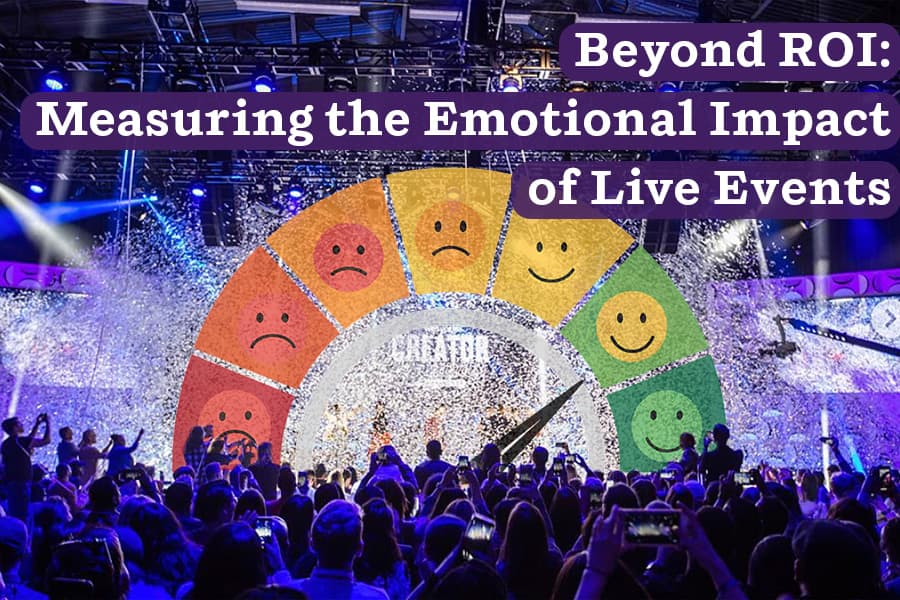
Post-event reports are great for breaking down the important numbers. They show what you spent, how many people came, return on investment, even foot traffic patterns, and more. These numbers help teams justify budgets and plan for the year ahead. But more often than not, they still leave out something that is becoming more and more important in improving your events year over year: How did it make your guests FEEL. As cheesy as it might sound, science is showing more and more just how much this matters in the performance of future events.
The Science Behind Emotion in Events
Live events are human experiences. People remember how they felt in the room, not only what they saw on the screen. Neuroscience research shows that emotions tag memories in the brain, which makes them easier to recall later. That link between the emotion center (the amygdala) and the memory center (the hippocampus) helps explain why charged moments stay sharp long after neutral moments fade. (Columbia Engineering)
Newer work even shows that strong emotional events can “rescue” weak memories around them, so a powerful keynote or shared moment can lift the memory of smaller touchpoints too. (Neuroscience News)
Event leaders are catching up to this. Many now track “other ROs” like return on emotion and experience, not just return on investment. (BizBash)
These leaders know something simple. If your event changes how people feel about your brand, team, or mission, the financial value follows.
So the question shifts from “Did it work?” to “How did it feel, and what did that change?”
What Emotional Impact Actually Looks Like
When we say “emotional impact,” we are not talking about grand speeches or sappy moments. We are talking about concrete emotional impacts that shape behavior.
Research on meetings and events points to a few key emotional outcomes.
Belonging
Events that build trust and social connection create a strong sense of “I fit here.” When people feel part of a group, they take part in more sessions, talk to more peers, and stay engaged for longer. This feeling often carries into future programs because people return to places where they feel seen and supported. (PCMA)
Psychological safety
When people feel safe to speak, ask questions, or try new activities, they open up. They take more risks during workshops, join discussions, and use the event to learn in a real way. That sense of safety makes the content stick and builds a deeper link between the attendee and the host group. (Outsourced Events)
Pride and identity
Events that highlight shared wins, strong values, or a clear mission can spark pride. This is powerful because pride shapes identity. When people see themselves reflected in the story of a company or community, they feel more loyal to it. This can improve well-being, retention, and long term support. (Heartwise)
Joy and surprise
Joy boosts energy. Surprise boosts memory. When an event includes moments that break the script, people light up. Their brains tag these moments as important, which helps them remember both the big themes and the small details around them. Even one strong moment can lift the whole experience. (PsyPost)
Putting in event terms, emotional impact sounds something like this:
“I felt welcome from the first touchpoint.”
“I met people who get me.”
“I feel proud of my team and company.”
“I left with new energy for the work.”
These are not “soft” outcomes. They drive repeat attendance, referrals, support for programs, and brand love that outlasts a single event cycle. That is why many teams use “return on experience” (ROE) along with ROI, to track human value like connection, learning, and satisfaction.
A Simple Framework: from ROI to ROE
You do not need a lab to measure emotional impact. You need a clear frame, a few right questions, and the discipline to use them every time.
Here is a three-part frame you can adapt for your next live event.
1. Before: emotional expectations
Emotional questions to ask before people arrive:
How curious are they about the event?
How confident are they that it will be worth their time?
Do they feel welcome and included based on invites and pre-comms?
You can track this with a short pre-event survey or pulse check, or by watching sign up speed and engagement with pre-event content. Event pros now pay close attention to the registration journey and how it signals interest and trust, not just final headcount.
Sample pre-event questions:
“On a scale of 1 to 10, how excited are you to attend?”
“How confident are you that this event will be valuable for you?”
“Do you feel this event is designed with people like you in mind?”
2. During: in-the-room emotion
Once people are on site, you want to know how they feel in real time, not just if they showed up. Industry leaders are moving beyond simple attendance and dwell time to track emotional engagement and experience quality.
Ways to sense this:
Quick in-event polls
One to two questions on the event app or a QR code at key moments, such as “Right now, I feel energized / neutral / drained.”Staff observation
Many teams now ask staff to log attendee comments and reactions during the event, since live feedback can reveal what people loved or missed.Body language and behavior
Where do people linger? Are small groups forming? Are people smiling, taking photos, clapping, or jumping into activities?
For teams that want deeper data, wearable tech and biometric tools can track real time emotional engagement. These tools use signals like heart rate and other markers to map when people are most focused and emotionally connected. (Immersion)
Even if you do not use advanced tools, you can still treat emotion as a metric. Give each main session, space, or touchpoint a simple “energy score” during your internal debrief.
3. After: memory, advocacy, and change
The emotional impact of an event often shows up days or months later. Toolkits for community and cultural events suggest checking in at set intervals, such as 1, 3, 6, or 12 months, to see what stuck and what changed.
At this stage, you want to know:
What do people remember most clearly?
How do they feel when they look back?
What did they do because of the event?
This is where post-event surveys shine. Best practice guides recommend a mix of simple rating questions and a few open prompts that invite stories. (Delighted)
Sample post-event questions tied to emotion:
“I left this event feeling more connected to [our company / this community].” (1 to 5 scale)
“I felt welcome and included throughout the event.” (1 to 5 scale)
“How proud did this event make you feel about your team or organization?” (1 to 5 scale)
Open prompt: “Describe one moment from the event you still think about.”
You can then link emotional scores to harder metrics like renewals, donations, sign ups, or repeat attendance. Some membership and event platforms now track how emotional and practical satisfaction scores connect to long term retention. (GlueUp)
Design Choices That Boost Emotional Impact
Measurement matters, but design comes first. You cannot measure a feeling that is not there. Research on brain friendly meetings points to a few design choices that help create strong, positive emotional impact. (SmartMeetings)
Consider building in:
Multi-sensory moments
Engage more than sight and sound. Thoughtful light, sound, scent, and texture support deeper memory and emotional tagging in the brain.Small group time
Give people time in circles or pods, not only in rows. Small group tasks and surprise prompts can drive laughter and bonding, which release chemicals linked to trust and connection.Shared purpose activities
Service projects, creative builds, or cultural experiences can increase a sense of meaning and belonging that lasts well beyond the event.Spaces that signal inclusion
Clear wayfinding, diverse imagery, quiet zones, and thoughtful seating can help more people feel they belong in the space.
When you design for specific feelings on purpose, you give your measurement plan something real to test.
Bring It All Together In Your Next Debrief
For your next live event, try this shift in your post-mortem:
Start with feelings, then move to numbers
Open your debrief with one question: “How did people feel in the room, and how do we know?” Use staff notes, live polls, and attendee quotes before you pull up the dashboards.Use a shared emotional scorecard
Pick 5 to 10 emotional items that matter most to your brand and audience. Use them across events so you can benchmark over time.Link emotional data to business outcomes
Compare high-emotion events or segments with later actions: sign ups, renewals, sales, or advocacy. Look for patterns instead of one-off wins.Close the loop with your audience
Share back what you heard and what you plan to adjust for next year with this year’s attendees. This builds trust and shows you value both practical and emotional feedback.
Closing Thoughts
When you start measuring how your events make people feel, you get a sharper picture of impact, you design with more intent, you ensure that your event leaves a lasting impact with your guests, and you have a stronger story to tell the next time you ask people to show up.
Ready to build an event with real emotional impact? We can help you find a space designed for connection, energy, and memorable moments. Contact our Team to schedule your personal walkthroughs today!