
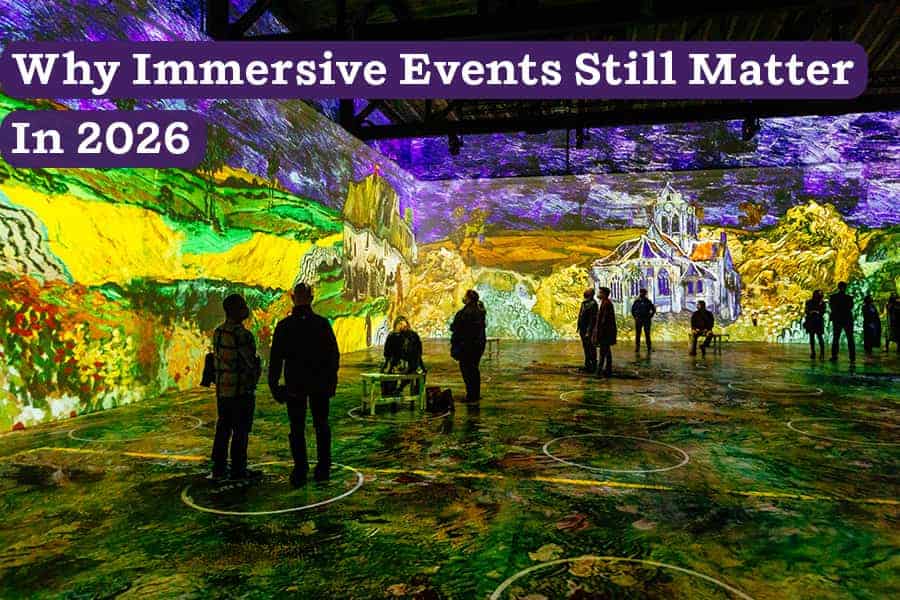
Not long ago, immersive events felt like the shiny new thing.
Now they feel less like a trend and more like part of the new baseline for live experience design.
That shift matters.
In 2026, immersive events are less about novelty and more about designing live experiences people can actually step into. The strongest ones do more than look impressive. They give people something to move through, react to, and remember once the event is over.
That is part of why immersive events still matter. People have no shortage of content, screens, or ways to spend their time. If an event is going to ask for travel, attention, and budget, it needs to feel worth showing up for. It needs to create something distinct in the room.
That is where immersive experiences continue to stand out. Done well, they pull people out of passive mode. They create energy. They make the environment part of the story instead of just the place where the story happens.
And there is still real appetite for that kind of experience. Eventbrite’s 2026 Social Study found that 79% of 18 to 35-year-olds plan to attend more events in 2026, and nearly half said they want events to feel less curated and more real. That says a lot about where the market is right now. People are still showing up. They are just looking for experiences that feel more alive when they get there.
What Immersive Events Actually Mean In 2026
The term “Immersive” has almost become the “AI” of the event world.
For a while, it seemed to describe almost anything with strong visuals, interactive elements, or a bit of production drama. But in practice, immersive events have always worked best when they do something more complete than that.
They build an environment people can enter, not just look at. They give attendees a stronger sense of place, progression, and presence. In some cases that comes from technology. In others, it comes from layout, pacing, scenic design, or the way an event reveals itself over time.
That is why the idea still holds up, even if the label gets stretched. People may not need every event to call itself immersive. But they still respond to experiences that feel layered, participatory, and hard to reduce to a single stage moment.
You can see that in the kinds of immersive experiences that continue to draw demand at scale. teamLab, for example, welcomed more than 4.2 million visitors to their two Tokyo immersive museums in 2025. Experiences like that do not pull those numbers if audiences are over the format.
Why Immersive Events Still Matter
The case for immersive events in 2026 is not just creative. It is practical.
Live events are competing against convenience more than ever. People can watch content anywhere. They can catch recaps later. They can get the headline version without ever stepping into the room. That raises the bar for what in-person events need to deliver.
Immersive environments help meet that bar by making attendance feel more experiential and less transactional. They act as a destination worth being in person for. They give people more to notice, more to explore, and more to talk about afterward.
There is also still real momentum behind the broader category. Grand View Research estimates the global immersive entertainment market reached $137.7 billion in 2025 and is projected to keep climbing in the years ahead. That does not mean every event needs to chase the category. It does mean this is not some fading side trend.
How Immersive Event Technology Fits In Now
Technology still plays a major role in immersive events. VR, AR, projection, responsive lighting, spatial audio, and motion-based systems all expand what a live environment can do.
What has changed is the way those tools are being used.
A few years ago, it was easier for technology itself to feel like the attraction. In 2026, it works better when it feels integrated into a larger idea. The best immersive tech choices now tend to support mood, movement, storytelling, or interaction without taking over the entire identity of the event.
That shift also reflects what attendees actually respond to.
Freeman’s recent attendee research found that 61% of attendees define immersive experiences as hands-on product interaction. The same report says attendees who experience a standout, goal-aligned peak moment are 85% more likely to return.
A useful reminder that technology can strengthen an experience, but it still has to lead somewhere.
Why Venue Choice Matters for Immersive Events
enue matters more here than people sometimes admit.
When an event is trying to create a stronger sense of atmosphere, progression, or discovery, the room is doing more than hosting. It is shaping the experience from the start.
That can happen in different ways. A blank-canvas venue like The Brighton can be powerful because it gives you room to transform. A historic venue like The Mint can be powerful because it gives you texture, atmosphere, and a sense of place before you even add much. It gives you a base to build upon. Neither is automatically better. But either one can do a lot of heavy lifting if the concept actually responds to the space instead of forcing it to fit.
That is especially important for immersive events because flow matters. What people see when they arrive, what gets revealed later, where the room opens up, where it narrows, where attention gathers, where it drifts, all of that changes how the event is felt.
For brands, that can make the difference between an activation that feels temporary and one that feels fully realized.
Immersive Events Need Engagement, Not Just Spectacle
This is probably the clearest dividing line now.
An immersive event does not succeed just because it looks impressive. It succeeds when people feel involved in what is happening.
That involvement can take different forms. It might be hands-on interaction. It might be movement through a series of spaces. It might be discovery built into the layout. It might be a reveal that lands because the room has earned it.
What matters is that attendees are not just sitting in front of the experience. They are inside it in some meaningful way.
That is also where some immersive events fall short. Strong visuals can create anticipation, but they do not automatically create connection. The events people tend to remember are usually the ones where something clicked while they were actively engaging with the space, the content, or the people around them.
Conclusion
Immersive events still matter in 2026 because they give live experiences a stronger reason to exist in person.
Not because every event needs to be louder. Not because every room needs a layer of tech. And not because “immersive” is the word of the moment.
They matter because audiences remember experiences that feel distinct once they are inside them. Experiences with atmosphere. With shape. With interaction. With a point of view.
That is a higher standard than a few years ago.
But it is a better one.
Looking to explore some possible spaces for your next immersive event? Non Plus Ultra can help! Contact Us today to book your personalized tours of our impressive venue portfolios in Denver and San Francsisco!