
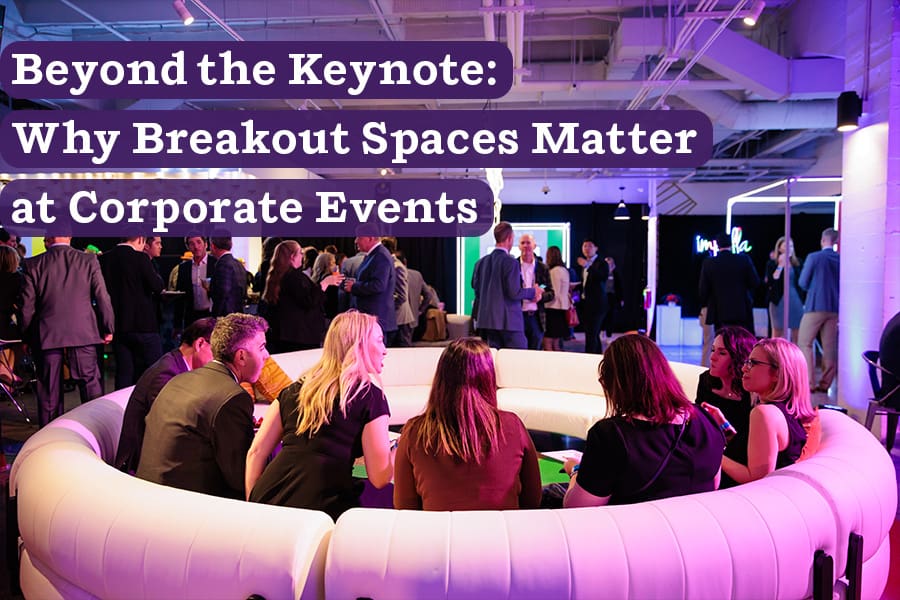
In corporate event planning, it is easy to assume the most important part of the experience is the most visible one.
-The keynote that anchors the day.
-The main stage moment everyone gathers for.
-The speaker or reveal that shapes the schedule around it.
It makes sense. Those are the moments that anchor the run of show. They are the pieces that shape the schedule, guide the room setup, and usually carry the most visibility before and after the event. Breakout spaces and other considerations quickly become secondary.
But ask people what they actually remember from a great event, and the answer is often something else entirely.
It is the conversation that happened after the keynote.
-The unexpected introduction in a lounge.
-The quiet reset between sessions.
-The discussion in a breakout space that led to new business.
Those moments do not usually happen at the podium. They happen around it.
That matters more now because in-person events are no longer experienced in a straight line. Attendees move between sessions, follow conversations that were never on the agenda, and look for time to regroup, connect, or process what they have just heard. Cvent recently reported that event design is shifting toward attendee-led personalization and more purposeful spaces, with planners thinking more carefully about how environments support meaningful interaction, not just programmed content.
For corporate event planners, brand teams, and immersive producers, that is the real shift. The strongest events are not built only around what happens on stage. They are built around how people move through a space, where they gather, when they pause, and what helps them connect once the formal programming ends.
A keynote can still create a shared moment. But what gives that moment staying power is often what happens next, when people have the space to respond to it, discuss it, and turn it into something real.
That is where breakout spaces start to matter.
Why Breakout Spaces and Networking Areas Matter More Than Ever
One of the clearest shifts in the industry right now is a more honest understanding of why people attend live events in the first place.
For many attendees, the value is not just the content. It is the access. The exchange of ideas. The relationships. The feeling of being in the room with the right people at the right time.
Freeman’s networking research found that 51% of attendees say successful networking is reason enough to return to an event. The same research found that 56% define networking success as gaining new ideas, while 33% associate it with a sense of community.
That matters because it reinforces something planners already know intuitively: networking does not only happen during the part of the agenda labeled networking. It happens in the event’s margins.
It happens on the way out of a session. In the courtyard after a panel. At a lounge table where someone stops for a few minutes and ends up staying for half an hour. In a breakout room that feels open enough to invite discussion.
That is one reason breakout spaces matter so much. They create the conditions for connection without forcing it. They allow conversations to happen naturally, which is often when they matter most.
And in a moment when so many events are being asked to prove their value more clearly, that kind of space becomes even more important.
People Need Spaces to Breathe and Places to Engage
One of the easiest mistakes in event planning is assuming that a jam-packed schedule always feels like a valuable one.
Sometimes it does.
Sometimes it just feels exhausting.
Attendees want to learn, connect, and stay engaged, but they also need room to breathe. Hilton’s Meetings & Events Trends reporting found that 78% of respondents say they sometimes need a break or time to themselves at a work event, and 65% said having dedicated quiet areas to work or check emails would make them feel more comfortable at in-person events.
Those are stats that cannot be ignored, and should absolutely shape how events are designed.
The best event environments are not the ones that keep people moving nonstop. They are the ones that understand human pacing. They make equal space for programming and recovery. They give attendees options.
That might mean a lounge that actually feels comfortable enough to linger in. A courtyard that offers a reset without disconnecting guests from the rest of the experience. A mezzanine that opens up movement and creates natural social spillover. Breakout rooms that feel conversational instead of overly formal.
These are not secondary spaces in any meaningful sense. They are an integral part of how the event works.
They help people stay present longer because they make the experience feel more navigable, more welcoming, and more human.
What Breakout Spaces Say About an Event Venue
This is where venue selection becomes even more strategic than it might seem at first glance.
It is easy to focus on the obvious checklist items first. Capacity. Ceiling height. Load-in. AV. Catering logistics. Number of rooms. All of that matters.
But there are other questions worth asking early in the process:
-What kind of behavior does this event venue naturally support?
-Does it help people gather easily?
-Does it allow movement to feel fluid instead of congested?
-Does it create room for both focus and recovery?
-Does it offer different areas for different experiences, or does everything have to happen in one room?
IACC’s Meeting Room of the Future report, based on insights from more than 200 meeting planners worldwide, points to the growing importance of physical attributes, food and beverage, technology, and social impact in how venues are evaluated. Its framing is useful because it reinforces that meeting environments are no longer judged only by function. They are judged by the quality of experience they help create.
That is one reason distinctive venues continue to stand out.
Not simply because they look different, but because they often give planners more to work with. More range. More texture. More movement. More opportunity for an event to unfold in layers instead of being forced into a single-room experience.
The Palace of Fine Arts is a strong example of that. The main show floor can hold the marquee moment, but it does not have to carry the entire experience on its own. The mezzanine creates a natural second layer overlooking the action below, which can be used for a change in perspective, a quieter conversation, or a VIP moment that still feels connected to the energy of the room. The multiple breakout spaces create even more flexibility, giving planners room for smaller discussions, side programming, or a reset between larger moments without losing the thread of the event.
That is often what makes an event venue feel so effective in practice. Not just that it has a beautiful main room, but that it gives the event places to breathe around it.
The keynote may still be the centerpiece. But the surrounding spaces are often what make the overall experience feel alive.
For Immersive Events, the Breakout Spaces Are Part of the Story
The strongest immersive experiences understand that people do not engage only through focal moments. They engage through pacing, atmosphere, transitions, and environment.
That is why breakout spaces matter so much for immersive events.
Not because every square foot needs to be activated to the same degree, and not because every corner needs its own “moment.” Usually that is where things start to feel overdone. The better approach is to let the side spaces carry the atmosphere forward in a way that feels natural, not overwhelming.
If the main experience is moody and cinematic, you do not want guests stepping out into a side room that suddenly feels flat and generic. Maybe the lighting stays low and warm. Maybe the music softens, but still feels like it belongs to the same world. Maybe the materials at the bar or lounge still echo what is happening in the main room, just with less intensity.
The same goes for an event with a more playful or high-energy tone. If the main show feels bright, social, and a little unexpected, the breakout spaces should not feel like an afterthought. That might show up in smaller interactive moments, a bar setup with some personality, furniture that invites people to gather instead of scatter, or little design cues that keep the energy moving even when nothing formal is happening.
Brand-driven experiences especially need that kind of continuity. If a company spends all this time building a clear visual language, a strong voice, and a specific tone for the main event, it is a missed opportunity when the breakout spaces revert to generic signage and standard setups.
Sometimes the most effective touches are the quieter ones: wayfinding that actually sounds like the brand, breakout rooms that feel named with intention, staff touchpoints that match the tone of the event, or styling choices that still feel connected without hitting people over the head with it.
That is usually the difference between an immersive event that feels fully considered and one that feels strongest only in flashes.
The main room may give people the peak moment. The breakout spaces are often what make the whole thing hold together.
Takeaways for Event Planners
If there is one takeaway here, it is this:
Do not judge a space only by what it can hold. Judge it by what it can support.
The keynote room matters. Of course it does. But so do the lounges, courtyards, breakout rooms, mezzanines, and transition spaces that help people connect the dots around it.
Those are the spaces that can turn content into conversation. Attendance into engagement. A tight run of show into something that still feels generous and human.
The events people remember are rarely the ones that only delivered information efficiently. They are the ones that gave people room to think, room to connect, and room to feel part of something while they were there.
That does not happen by accident.
It happens when breakout spaces are treated as part of the strategy, not just part of the floor plan.
Because sometimes the most important thing at an event is not what happened at center stage. It is what happened just outside of it.
If you are planning an event and want to explore corporate event venues that offer more room for connection, movement, and layered experiences, reach out to the NPU team to learn more or schedule a walkthrough.