
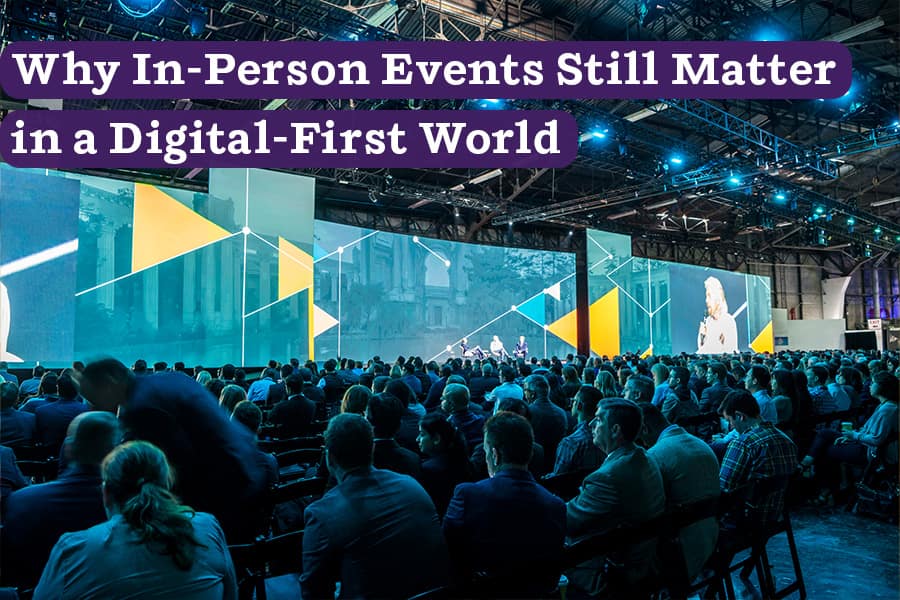
A few years ago, it was fair to wonder whether virtual and hybrid events might make in-person gatherings feel less necessary.
Thankfully, that never came to pass.
People are still showing up. Brands are still investing in live experiences. Planners are still looking for rooms that can bring the right audience together in a way a screen cannot. The question now is whether each event gives people a strong enough reason to commit the time, budget, travel, production, and attention it takes to gather in person.
Virtual and hybrid events have earned their place in the event world. They help teams reach wider audiences, extend content, and make programs more accessible. Still, they have not replaced the pull of being in the room. When the goal is to build trust, create energy, open up real conversation, or give a moment the weight it deserves, the live experience still has an advantage.
That sentiment is also showing up in the numbers. ATN’s experiential marketing report found that 82% of event attendees prefer in-person events, compared to just 1% who prefer virtual formats. For planners, that preference is only part of the equation.
The business case for live events has grown sharper as well. Bizzabo’s State of Events report points to live events playing a significantly larger role in pipeline development, customer relationships, deal acceleration, and measurable outcomes.
The question is not whether in-person events still matter. It is what makes an event worth showing up for in the first place.
The Limitations of Digital Engagement
Virtual and hybrid events have their place. They can open up a program to people who could not travel, help a message reach beyond the room, and give teams another way to keep the conversation going after the main event is over.
Still, these formats have their own special frictions. Anyone who has sat through a virtual event has felt it.
Distraction
The urge to multitask during an online keynote or virtual session can be overwhelming. IIt is all too easy for attendees to run the session in a background window while browsing the internet, checking email, or taking care of other work, leading to missed information and lower retention. This can happen with even the strongest of content.
Technical Hurdles
Weak Wi-Fi, confusing platforms, late login links, muted microphones, lagging video, screen-share issues, and unfamiliar tools can all pull attention away from the program. Even when the content is strong, the experience is still being filtered through a device, a connection, and whatever else is happening on the attendee’s screen.
Lack of Personal Connection
A virtual chat room can support basic discussion, but it has a harder time creating the loose, human parts of an event that planners often care about most. The quick introduction before the program starts. The conversation that continues after a session ends. The shared laugh, reaction, or moment of surprise that gives people something to talk about later.
These factors aside, digital formats are still useful for teams trying to maximize reach, share information quickly, or give remote audiences a way into the conversation. But their convenience has also raised the standard for live events. If people are going to make the effort to be physically present, the experience needs to offer more than a presentation they could have watched from their desk.
Digital Convenience Has Raised the Bar for Live Events
Virtual and hybrid events changed the event industry in a practical way. They gave planners more ways to reach people, more ways to distribute content, and more options when an audience could not all be in the same place.
They also made one thing harder to ignore: not every message needs a room.
A product update can be emailed. A keynote can be recorded. A panel can be streamed. For the right goal, those formats make sense. But when a company decides to bring people together in person, the event has to offer something digital formats cannot carry on their own.
That is where the planning bar has moved. A live event needs to give attendees a reason to make the trip. Guests are more likely to show up when there is access they cannot get elsewhere, like a chance to meet leadership, speak directly with customers, experience a product in person, celebrate a real milestone, hear from industry experts, enjoy a performance, or spend time in a setting that feels different from their everyday routine.
In that way, digital convenience has not weakened live events. It has made the best ones more intentional. The strongest in-person events do not try to compete with digital channels on convenience. They give people something worth leaving the screen for.
In-Person Events Create Stronger Connections
Networking is usually part of the pitch for live events, but the real value is not just handing someone a name badge and hoping the room does the rest.
Good in-person events make connection feel easier. People can read the tone of a conversation. They can catch someone after a session, schedule focused breakout meetings, or meet a person they never would have scheduled time with on a calendar. The best moments often happen in the spaces between the formal programming.
That kind of connection has become more important as teams, customers, and communities have spread out. A company can stay in constant contact through email, Slack, video calls, and social platforms. Still, there are moments when being together changes the quality of the conversation.
A customer reception can make a business relationship feel more personal. A company celebration can give employees a shared memory outside the usual work rhythm. A conference-adjacent event can pull people out of the churn of the show floor and into a room where the conversation has more room to breathe. A fundraiser can bring supporters closer to the mission and to each other.
Hilton’s recent meetings and events research points to the same human need, noting that 84% of attendees say they enjoy bringing their authentic selves to work events. Guests are not only looking for a smooth check-in and a tight run of show. They are looking for enough comfort, interest, and energy to actually participate.
That is also why breakout spaces at corporate events have become such an important part of the guest experience. Not every valuable exchange happens in front of the stage. Some of the best ones happen near the bar, in a side room, on the way to the next session, or during the part of the night no one over-scheduled.
For planners, genuine connection is no longer an event bonus. It is now one of the clearest reasons to gather people in the first place.
Live Events Give Direct Access and Firsthand Experiences
One of the strongest advantages of an in-person event is that guests can do more than watch.
They can move through the space. They can test a product. They can speak directly with the people behind a brand. They can ask questions in the moment, compare notes with other attendees, and experience the environment around the program.
The event becomes more than a content delivery channel. A product launch can include real-time demos, tactile displays, live reactions, and conversations with the team that built it. A corporate event can give clients and partners direct access to leadership and industry experts. A fundraiser can bring supporters closer to the mission through visuals, storytelling, performances, and personal interaction. A conference-adjacent reception can create space for real conversations away from the noise of the show floor.
It is also where immersive events and brand activations continue to stand apart. True immersion is hard to achieve when the experience is contained to a screen. In person, guests can step into a branded environment, move through different zones, interact with products, feel the scale of the room, and become fully enveloped by the atmosphere around them. That kind of participation gives the brand more than visibility. It gives the audience something to do, remember, and talk about afterward.
This is not just a nice-to-have. Freeman’s Commerce Report found that attendees look to in-person events for practical, business-driving moments, including discovering new products and solutions, meeting with providers, speaking with subject matter experts, comparing offerings, and testing products they have been investigating.
A screen can show the product, the speaker, or the brand message. A live event lets guests engage with it directly. That is where in-person events continue to carry real weight in a digital-first world: they give people something to experience, not just something to absorb.
Added Value Past the Live Event
A strong live event does not stop working once the lights come up.
Guests carry the conversations, photos, introductions, and impressions with them. Sales teams have a more natural reason to follow up. Marketing teams have real moments to share. Internal teams have a shared reference point that can last well beyond the event itself.
That extended value is one of the reasons live events remain such a powerful part of a larger marketing or communications strategy. A well-run event can support customer relationships, social content, internal storytelling, press opportunities, recruiting, sponsor value, and future campaigns. But the value starts with the experience itself. The follow-up is stronger when the night gave people something specific to remember.
Smart event design can fuel year-round marketing content. The best event content usually comes from a room that already feels alive. Guests can tell when a moment is staged or genuine. Strong design creates environments that look good on brand channels while also encouraging attendees to capture and share moments on their own accounts.
For brands and organizations, that is the real opportunity. A live event can create the kind of shared memory that makes the follow-up feel less forced. The recap video, LinkedIn post, client note, sales conversation, or internal message all work better when they point back to a real, memorable experience people were glad to be part of.
The Right Venue Makes the Experience More Memorable
The right venue can directly shape the guest experience and help an event stay with people after the room clears. A product launch, reception, gala, or company celebration is easier to remember when it happened somewhere that felt unique. The space gives guests a visual and emotional reference point, making the event feel less like another item on the calendar and more like something they were glad to have attended.
That is why venue choice carries so much weight. Capacity, location, and logistics still matter, of course, but they are not the whole decision. The space has to support the kind of experience the planner is trying to create.
Nontraditional event venues are gaining more and more popularity because they give planners something more distinctive to build from.. When the room already has character, scale, and flexibility, the event does not have to work as hard to feel distinct.
A historic venue like The Mint gives a gathering an immediate sense of character. A landmark setting like the iconic Palace of Fine Arts can bring scale and visual drama to a major launch, gala, or cultural event. A flexible urban venue like SVN West gives planners room to build something expansive and highly customized.
The space does more than hold the program. It shapes the arrival, the movement, the photos, the conversations, and the way the night is remembered after everyone leaves.
Why Live Events Still Matter
In-person events are not growing because planners are returning to old habits. They are growing because the need for real-world connection has become more urgent, more strategic, and more valuable than ever.
Digital channels are crowded. Audiences are selective. Attention is harder to earn. Brand trust is harder to build. Teams are more distributed. Customers have more options. Communities are looking for places to gather in ways that feel genuine.
A well-planned live event can solve for all of this under one roof.
It can bring people into the same room. It can turn a brand message into a physical experience. It can make a product launch feel more consequential. It can give customers and partners a reason to connect beyond the inbox. It can give guests direct access to products, experts, leadership, and the people behind the brand. It can create content with depth because the experience itself had depth. It can give a company milestone the setting it deserves.
The call for planners in 2026 is not simply to host more in-person events. It is to host better ones.
That means choosing venues with intention. Designing for connection, not just attendance. Building moments that feel specific to the audience, the brand, the city, and the reason everyone gathered in the first place.
In a digital-first world, the strongest live events give people something worth leaving the screen for: a room full of energy, a reason to connect, and a moment that stays with them after they leave.
Ready to create an in-person event that gives people a reason to make the trip? Start planning your next San Francisco event with NPU today.