
As December arrives, most teams are running on a strange mix of momentum and exhaustion.
There are projects to finish, goals to review, budgets to close, and plans already forming for the year ahead. There is also the quieter part of the season: looking back at what people actually helped build. The launches that worked. The problems that got solved. The late nights nobody outside the team saw.
That is why a company holiday celebration still has a place.
A well-planned holiday event gives a company one of the few natural moments in the year to pause. It brings people together outside the usual pace of work and gives leadership a visible way to recognize the effort behind the year.
At its best, the gathering feels less like another item on the December calendar and more like a clear marker: the work mattered, the people behind it mattered, and the year is worth closing together.
Why Company Culture Matters in Holiday Party Planning
Workplace connection takes more effort than it used to.
Hybrid teams do not always share the same office rhythm. Remote employees may only see coworkers a few times a year. Even teams that work in person can move so quickly from one deadline to the next that there is little time to step back and acknowledge what the group has been through together.
This growing need for team building is becoming evident in the numbers as well. According to Gallup’s 2025 workplace findings, U.S. employee engagement fell to a 10-year low in 2024, with only 31% of employees engaged. Of course, a holiday party will not solve that on its own. But it can help address it by giving employees something many workplaces are missing: time together that is not tied to a meeting agenda, project update, or quarterly goal.
That simple pause can be a surprisingly powerful tool. It gives people a chance to reconnect outside their usual teams. It gives leadership a moment to thank employees in person. It gives the year a clearer ending than another recap email or Slack message. Most important of all, it gives the full team a chance to come together in a meaningful way that builds a real sense of camaraderie.
Recognition Belongs at the Center of the Holiday Celebration
A holiday party should give people a good night out. It should also make them feel like the year they just worked through was seen and appreciated.
That is what separates a thoughtful year-end celebration from a nice party with a holiday theme. After months of deadlines, decisions, pivots, and problem-solving, employees should not have to guess whether their effort was noticed. A year-end event gives leadership a chance to say it clearly, in front of the people who helped make the year happen.
Gallup and Workhuman found that well-recognized employees were 45% less likely to have changed organizations two years later. That tracks with what most people know from experience. A generic thank-you fades quickly. Specific recognition in front of colleagues tends to stay with people longer.
A few ways to bring recognition into the night without slowing it down:
- A short toast that names real wins from the year
- Peer-nominated awards with categories that feel true to the company
- A visual recap of major milestones, launches, or moments
- A charitable giving element tied to employee-selected causes
- A printed or digital yearbook-style recap
- A thank-you moment for teams whose work is often behind the scenes
The point is not to turn the evening into a performance review. It is to make appreciation feel connected to real work, real people, and a real reason for the whole team to celebrate.
The Best Holiday Events Give People Something to Do Together
People may not remember every speech, menu item, or playlist choice from a holiday party. They are more likely to remember what they did together.
That shared experience is a big part of why year-end gatherings can carry value. They give employees a memory that belongs to the group, not just to a department, project team, or leadership circle. That is especially useful for companies with hybrid or distributed teams, where shared moments can be harder to come by.
A study published in Scientific Reports found that external locations, fun activities, informality, and symbolic elements were associated with higher employee satisfaction with company Christmas parties.
That finding lines up with what tends to work in the room. People want enough activity to give the night energy, but not so much structure that the event feels managed minute by minute.
A few formats can help create that sense of shared experience:
- Food and drink stations that encourage guests to move through the space
- Live music or a DJ to shift the energy as the night progresses
- Photo moments connected to the venue, team, or theme
- Light interactive activations, games, or creative challenges
- Lounge areas for people who want real conversation
- Short entertainment sets instead of one long program
- A theme that gives the event some identity without taking over the night
The right mix depends on the company. Some teams want a packed dance floor. Others care more about good food, comfortable conversation, and a relaxed night with coworkers they do not see often enough. The strongest events make room for different ways of participating.
A Celebration Only Works When People Want to Be Part of It
Throwing a holiday party is all well and good, but the event only works if it is something your team actually wants to attend, not another “mandatory fun” moment slipped onto the calendar.
That does not mean every detail has to appeal to every person. It means the celebration should feel easy enough, welcoming enough, and worthwhile enough for employees to say yes. The invitation should not feel like an obligation.
This is where practical planning connects back to the bigger purpose of the event. Food, timing, transportation, accessibility, seating, music, and communication all influence whether people feel excited about showing up and staying. These details may not be the headline of the celebration, but they shape how many people can actually enjoy it.
A few choices can make the event feel more accessible to the full team:
- Choose a location that is realistic for the majority of employees to get to
- Share transportation, parking, and rideshare details early
- Offer food options that account for common dietary needs
- Include alcoholic and non-alcoholic drinks that both feel event-worthy
- Create clear communication around dress code, timing, and guest policies
- Avoid programming that pressures employees to participate
- Consider whether a family-friendly element fits the company culture and event goals
The Scientific Reports study found that providing both alcoholic and non-alcoholic beverages was associated with lower dissatisfaction at company Christmas parties. That detail is useful, but there is a larger lesson here: when guests feel like the basics were handled with them in mind, the celebration becomes more enticing to attend and easier to enjoy.
A Real NPU Example: Facebook’s Winterbook at Pier 80
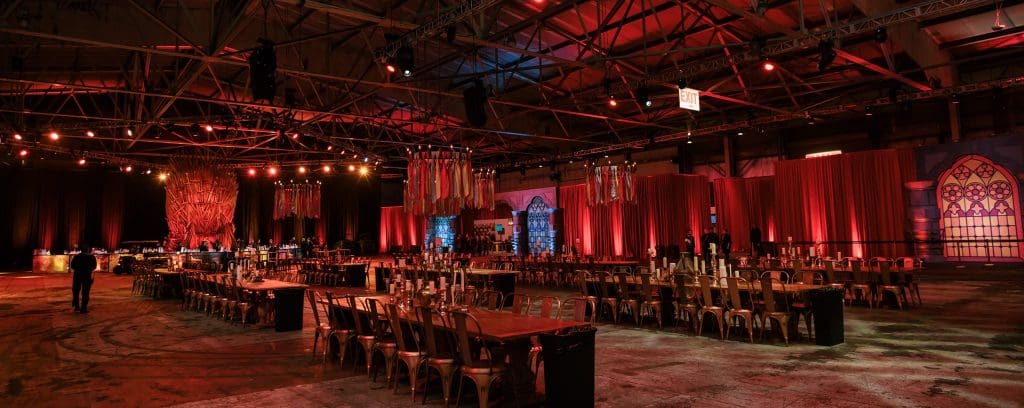
Facebook’s Winterbook celebration at Pier 80 is a useful example of how a holiday party can become more than a large seasonal gathering.
When Facebook set out to host its biggest holiday party to date, the goal was not simply to bring thousands of employees into one room. The event needed enough scale, movement, and variety to keep the night engaging across two separate evenings. With NPU’s help, the company selected Pier 80, a massive cargo terminal on San Francisco’s waterfront, and transformed it into a Game of Thrones-inspired experience.
That setting gave the event room to unfold in different ways. Guests could move through immersive environments, visit themed bars, take part in archery courses, encounter roaming White Walkers and dragons, or gather around larger visual moments like the towering Iron Throne. The party was not built around one activity or one version of celebration. It gave people different ways to participate while still keeping everyone inside the same larger world.
That is what made the event such a strong fit for this kind of year-end moment. It offered shared spectacle, smaller points of discovery, and enough variety for guests to shape their own night. The result was a holiday celebration that reflected the ambition of the company, gave employees something to experience together, and felt far removed from a standard end-of-year gathering.
You can read more about the project in How NPU Helped Facebook Transform a Massive Shipping Pier into the Ultimate Holiday Party Venue.
Why the Holiday Party Venue Matters
The setting of a holiday celebration should support the reason people are gathering in the first place.
If the event is meant to recognize a major year, the venue should feel equal to that moment. If the goal is to bring a distributed team together, the layout should make it easy for people to move, talk, eat, gather, and find their own rhythm throughout the night.
A memorable venue can also become part of the appeal for your team to attend. Sometimes the right fit is a historic space with built-in character, like The Mint. Sometimes it is an iconic San Francisco landmark with the scale for a full holiday gala, like the Palace of Fine Arts. And sometimes, the event calls for a massive industrial canvas like Pier 80, where a company can build an elaborate, immersive world that gives guests something to explore together.
When the venue has history, scale, architecture, or a clear point of view, the event feels less like a routine company function. It gives the team somewhere worth going, and gives the celebration a stronger chance of staying with them after the night is over.
The right setting should match the size, tone, and purpose of the celebration. A small executive dinner, a client appreciation event, a company-wide reception, and a large themed holiday party all benefit from a space that makes the gathering feel extra special.
Make the Year-End Gathering Count
A holiday party can be easy to dismiss as another seasonal tradition, especially when it feels like little more than decorations, drinks, and a playlist.
But when the celebration is built with real thought behind it, it can carry more weight than that. It becomes one of the few moments in the year when appreciation is shared in person, teams gather without the pressure of the next deadline, and the work behind the year is recognized in a way people can actually feel.
That is why holiday parties still matter. They give employees something to look forward to at the end of a demanding year. They create room for well-deserved recognition. They help teams feel special, appreciated, and part of something worth celebrating. And for companies with less face-to-face time than ever, they offer a rare chance to bring everyone together for a moment that is not built around work.
Non Plus Ultra offers iconic holiday party venues in San Francisco for companies that want their year-end gathering to feel more memorable than a standard seasonal event. Explore NPU’s full portfolio of holiday party venues in San Francisco, or contact our team to start planning a celebration your guests will actually want to attend.