
Choosing a venue is usually one of the first major budget decisions in the planning process. It is also one of the easiest to underestimate.
A proposal may look straightforward at first: the rental fee, the event hours, a few required services, and maybe a handful of optional add-ons. But the venue fee alone is rarely the only cost to consider when booking a space.
Some event costs are obvious. Catering, entertainment, production, furniture, florals, staffing, signage. Those numbers usually get debated, trimmed, defended, and reworked.
The quieter budget problems often come from venue details that are easier to overlook early, such as load-in conditions, access windows, power limitations, vendor rules, guest flow, or the amount of work required to make the space feel finished.
That is especially important right now. MPI’s Meetings Outlook notes that event teams are still investing in in-person experiences, but budgets are under pressure, costs continue to rise, and planners are being asked to prove the value of every decision more clearly.
In this environment, the better question is not, “What does the venue cost?”
It is, “What will we need to spend to make the venue work?”
Load-in Can Make or Break the Labor Plan
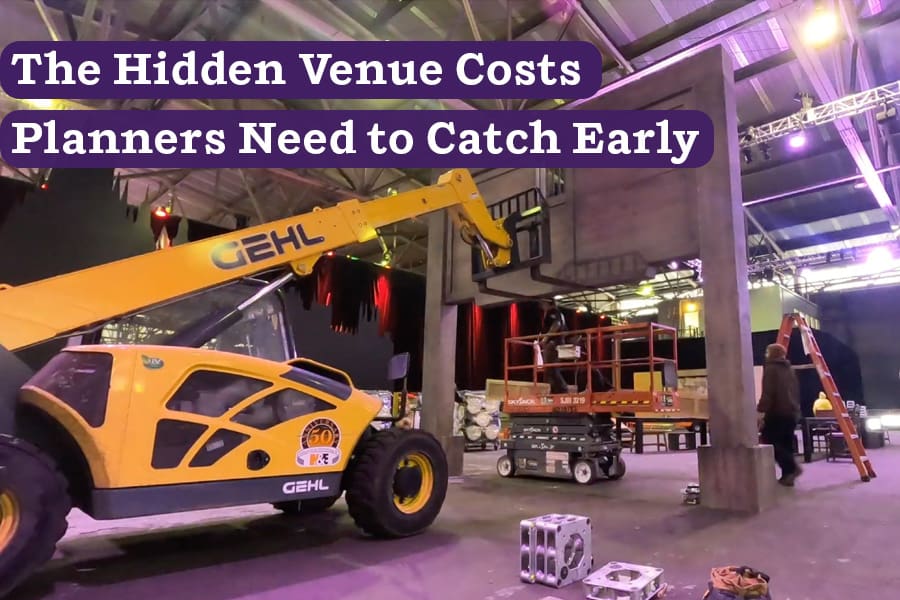
Load-in is never a glamorous part of an event, but it can have a very real effect on the timeline and budget.
A planner may fall in love with the main event space, the ceiling height, the architecture, the view, or the way the venue photographs. Meanwhile, the production team is looking at the loading dock, elevator availability, curb access, door widths, parking restrictions, and the distance from truck to install point.
That is where hidden cost starts to appear.
If a crew cannot easily get equipment close to the event area, the job quickly becomes far more labor-intensive. If everything has to move through several tight corridors, the timeline stretches. If there is no easy staging area, vendors may need to arrive in tighter waves. If street access is limited, delivery schedules become more fragile.
These factors quickly add up once lighting, sound, staging, catering equipment, furniture, scenic pieces, branded builds, and florals are involved.
Again, a difficult load-in does not automatically disqualify a venue. It just needs to be considered early on in the planning process. The production partner should see the space early, ideally before the contract is final. A technical walkthrough can reveal whether the budget needs more labor, more time, special equipment, floor protection, overnight access, or a different install plan altogether.
The earlier that conversation happens, the less likely it becomes an expensive surprise later on.
Blank Spaces Can Impact Cost More Than You Expect
There is a reason blank spaces are attractive to event planners. They give far more creative control to fully customize the space around the event.
But a blank space is not automatically an efficient space.
If the venue has little character on its own, the event has to build more of the atmosphere from scratch. That may mean bringing in pipe and drape to soften the space, renting lounge furniture to create places for guests to gather, adding scenic pieces to give the event a stronger focal point, or using lighting to make the space feel less flat. Branding, florals, signage, and custom installations may also need to do more work than they would in a venue with a stronger architectural presence. These additional investments can add up quickly.
Still, this can be the right choice for many events. A highly produced brand launch may need that level of control. A large conference may care more about function than architectural detail. For many events, though, a venue with existing character can take pressure off the decor and production budget.
This is one of the many practical advantages of NPU’s event venues. The Mint already offers stunning ballrooms, historic gold vaults, and a courtyard that give planners something substantial to work with. 620 Jones brings a layered indoor-outdoor setting with a built-in sense of mood, from its enclosed bar and dining areas to its large open-air garden patio. The Palace of Fine Arts gives planners a landmark setting with immediate recognition, substantial scale, and a built-in sense of arrival that can carry far more weight than added decor alone.
Of course, these spaces still need planning. Every venue does. But they do not require the same amount of visual invention as a space that begins with little atmosphere of its own.
Production Needs Can Change the Budget Quickly
Technical needs are easy to underestimate early in the process because they often feel separate from the venue decision.
They are not.
A reception, keynote, product reveal, concert, awards program, fundraiser, or multi-room corporate event all place different demands on a space. Power access, internet, lighting control, sound restrictions, rigging rules, backstage areas, green rooms, and vendor access can all affect the final production plan, as well as the cost.
If the venue cannot natively support what the event requires, the necessary fix will usually add to that spend.
That may mean generators, added power distribution, extra cable runs, additional lighting rentals, temporary internet solutions, more technicians, furniture rental, or a revised floor plan.
Time can create similar pressure. A tight setup window may look manageable until every vendor needs the same elevator, the same loading zone, and the same few hours in the venue. Compressed timelines can require larger crews, overnight work, overtime, or less margin for rehearsal, testing, styling, and troubleshooting before doors open.
Before booking, planners should understand the full access picture. Not just event hours, but load-in, vendor setup, rehearsal, sound check, strike, next-day pickup, and any hard stop times. They should also know what happens if the event runs long or if strike takes more time than expected.
Overtime policies, labor rules, security extensions, freight elevator schedules, and noise restrictions can all heavily affect the real cost of the venue rental.
Guest Flow Can Add Staffing and Infrastructure Costs
Guest flow often gets discussed in terms of experience. Are arrivals smooth? Can people find the bar? Does the space feel crowded? Is there enough room for networking, sponsor activations, food service, seating, and movement?
Those are guest experience questions, but they are also budget questions.
When a layout does not naturally support the way you want people to move, the event team has to compensate. More signage. More staff. More check-in points. More security. More stanchions. More satellite bars. More rented infrastructure. More troubleshooting during the event.
A bottleneck at arrival can require a larger check-in team. A bar placed in the wrong location can pull guests into a traffic jam. Restrooms that are too far from the main program may require more wayfinding. Sponsor areas without natural visibility may need more buildout to feel integrated.
Small layout issues get more expensive as guest count grows.
This is why a walkthrough should not only focus on where the stage goes or where the dinner tables fit. It should follow the full guest path. Arrival. Registration. Coat check. First drink. Main program. Food. Restrooms. Breakouts. VIP movement. Sponsor engagement. Exit.
The best layouts do not need guests to be managed through every transition. They make the next step feel obvious. When arrival, check-in, food, bars, programming, and exits are working with the natural movement of the venue, planners can spend less time and money solving traffic problems and more on shaping the experience itself.
Vendor Rules Can Change the Math
If a venue has a preferred vendor list, it can be a major advantage. These teams know a venue well and understand the quirks, restrictions, timing, kitchen conditions, load-in paths, and common pain points. That familiarity can save time and prevent mistakes.
But vendor rules still need to be part of the budget conversation.
If a venue requires specific caterers, beverage partners, A/V providers, rental companies, labor teams, or security vendors, planners need to understand how those requirements affect total spend. That includes minimums, service charges, staffing requirements, buyout fees, insurance rules, and whether outside vendors are allowed at all. This may also greatly limit a planner’s ability to control costs elsewhere.
A more flexible vendor structure gives planners room to bring in teams they already trust, compare pricing, and shape the event around specific creative or operational needs. That freedom can be valuable, especially for events with a distinct brand direction or specialized production plan. It also puts more responsibility on the planner to make sure every vendor understands the venue, carries the right insurance, follows the right timelines, and works well within the larger event team.
Neither scenario is automatically good or bad. The problem is finding out too late.
Better Questions Protect the Budget
By the time production begins, many of the venue conditions that shape the budget are already locked in.
The access window is what it is. The load-in path has already been accepted. The vendor rules are part of the agreement. The available infrastructure, guest flow, and overall character of the space are no longer abstract planning considerations. They are the conditions the event team now has to work within.
That is why in-depth venue comparisons need to happen with more scrutiny long before contracts are even signed. Planners should be looking beyond the rental fee and asking what it will actually take to use the space well, where the event may require extra labor or infrastructure, how vendor rules could affect total spend, and which costs tend to catch clients off guard after booking.
For planners comparing unique event venues, the goal should not be to find the lowest rental fee. It should be to find the space that creates the fewest unnecessary costs while still supporting the experience the event needs to deliver.
That is where NPU’s approach can make the planning process clearer from the start. With transparent pricing, adaptable venues, experienced venue teams, and spaces that already offer character, scale, and practical event infrastructure, planners can make decisions with a stronger understanding of what the event will actually require.
Contact NPU to explore venues that can support your event vision, your guest experience, and your budget before production ever begins.