
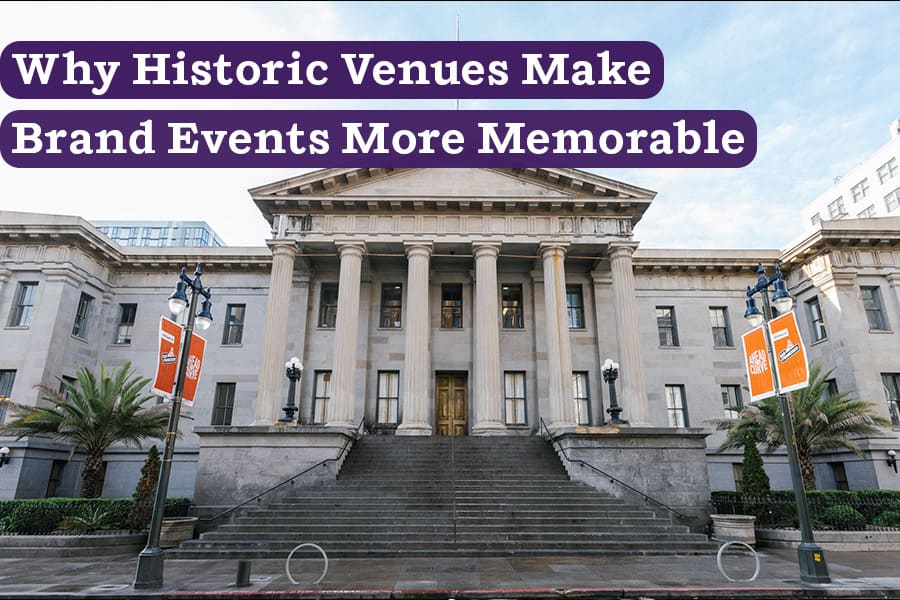
Brand events are often built around the future.
A new product. A new partnership. A new market. A new chapter for the company. The language is forward-looking, the visuals are polished, and the experience is designed to create momentum.
The challenge is that highly produced events can start to feel interchangeable when the setting has no real relationship to the story being told.
That is where historic event venues offer something rare. They give modern brand moments a concrete tie to a time, place, and memory. Their architecture, materials, and past use create context before the first speaker walks onstage or the first course is served.
Many also bring a level of recognition that cannot be built overnight. When guests see a familiar landmark on an invitation or arrive at a place they already associate with civic life, culture, or the city itself, the event begins with a sense of significance already in place.
For event planners, context can be a powerful tool. A product launch inside a historic venue can feel less temporary. A leadership dinner can carry more intimacy and significance. A summit can feel connected to something larger than the agenda.
That connection to place is especially valuable in markets like San Francisco, where the city’s history, industries, and creative communities can add meaning to the event itself. For planners thinking specifically about technology gatherings, we have also recently discussed why the Bay Area has become such a strong hub for AI and tech events.
The goal is not to borrow history as decoration. The strongest historic venues do not turn the past into a theme or ask the brand to perform nostalgia. They give the event depth, texture, and a more human sense of place.
Used well, a historic venue helps guests understand not only what a brand is saying, but why the moment deserves attention.
Using History Without Turning It Into a Theme
Historic venues are most effective when their history supports the event instead of becoming the entire concept.
A landmark building can bring recognition, texture, and emotional weight to an event, but guests rarely need a full lesson on the space to understand why it feels special. Too much explanation can make the experience feel heavy-handed.
The planner’s job is to decide which parts of the venue’s story help the brand message, which parts should guide the atmosphere, and which parts should simply stay in the background.
As an example, The Mint is a venue with a natural connection to value, exchange, preservation, and civic history. It played an important role in U.S. coin production from 1874-1937, and once held one-third of the nation’s gold reserves.
For a finance dinner, investor event, awards program, or leadership gathering, that history can add a quiet layer of relevance. A brief mention in the welcome, a line on the event page, or a subtle design reference may be enough. For another kind of event, the better choice may be to say very little and let the architecture carry the weight.
That is often where historic venues do their best work. The materials, scale, acoustics, circulation, and sense of arrival create atmosphere before anyone explains a thing. Guests may not know the full history of the building, but they know when a room has presence.
From a planning standpoint, the useful question is not “How do we tell the whole story of this building?” It is “Where does this building help our event feel more intentional?”
That answer may show up in the arrival experience, the dinner layout, the first toast, the closing reception, or the way guests move from one space to another. For corporate events with multiple sessions or networking moments, those in-between spaces matter more than they sometimes get credit for. We recently wrote about how breakout spaces shape the guest experience beyond the keynote, and the same thing applies here. In a historic venue, the corridors, terraces, lounges, and transition areas can become part of the memory of the event, not just the route between scheduled moments.
That being said, the brand still needs room to lead. A keynote, product demo, sponsor moment, or technical presentation may need a cleaner visual environment so the message is not competing with the building. A reception, dinner, performance, or closing celebration may benefit from letting the venue come forward. Finding that balance is what keeps the event from feeling over-themed and makes it truly special.
Used well, history does not need to announce itself at every turn. It can sit underneath the experience, giving the event more dimension without pulling attention away from the reason people gathered.
Authenticity Works Best When It Is Built Into the Space
Event audiences have become fluent in experience design. They notice when a space has been forced into a concept it does not naturally support. They also notice when everything feels seamless because the venue, programming, and guest journey are moving in the same direction.
Research published in Tourism Management Perspectives found that authenticity in events can help shape social value and destination connection, especially when events work within a broader ecosystem of place, people, and culture. In plain terms, authenticity is not a visual style. It is a relationship between the event and its surroundings.
Historic venues have an advantage here because they already belong to a place. Their value is not only aesthetic. They carry local memory, neighborhood identity, and civic texture.
For planners, this opens up a more layered way to think about brand fit.
A leadership retreat in a historic venue can signal humility and perspective. A fundraising gala can feel more connected to community stewardship. A product launch can borrow a sense of continuity, not by claiming history as its own, but by acknowledging that new ideas are stronger when they enter a room with a past.
The venue should not pretend to validate the brand. It should create conditions where the brand feels more believable.
Historic Venues Help Guests Remember the Moment
There is a practical reason planners keep returning to unusual, landmark, and adaptive reuse spaces: memory.
Guests may forget a stage treatment. They may forget the exact name of a breakout room. They are far less likely to forget descending into a gold vault, standing under the rotunda of a landmark, or stepping onto a rooftop with a city unfolding around them. Recognition strengthens that memory even more. When a venue is already part of the public imagination, guests do not need to be convinced that the setting matters. They arrive with a relationship to it, even if they have never attended an event there before.
The Palace of Fine Arts is a strong example. Its iconic rotunda, lagoon, and sweeping colonnades are among San Francisco’s most recognizable architectural images, and the site’s connection to the 1915 Panama-Pacific International Exposition gives it a place in the city’s civic history.
For events, that recognition carries into the experience without requiring the program to revolve around the building’s past. The venue’s scale, high ceilings, open interior volume, and historic character give planners a setting that feels significant as soon as guests step inside. A gala, conference, product launch, or performance does not need to manufacture a sense of occasion from nothing. The room already has one.
That is the practical value of a landmark venue. It gives guests a clear mental image before the event and a more memorable setting once they are there. “The event at the Palace of Fine Arts” carries a specificity that a generic venue description cannot match.
For brands, that can be the difference between an event that looks impressive in photos and one people continue to reference months later. That same logic is one reason off-site events during major conferences can make such a strong impact. When attendees are moving through crowded agendas, sponsor floors, and back-to-back programming, a distinctive venue can help your dedicated gathering stand apart from the noise.
The Venue Can Add Credibility Without Saying a Word
Credibility in event design is easy to overstate and hard to earn.
A historic venue can help because it often come with built-in credibility all its own. It was not built for this one brand, this one campaign, or this one evening. It existed before the event and will remain after it. That permanence gives the gathering a different kind of weight.
Sometimes that credibility comes from recognition. The Palace of Fine Arts is an easy example. People know it. They have seen it in photos, passed it in the Marina, brought visitors there, or associated it with San Francisco long before they attend an event within its walls. When a brand hosts something in a place like that, the setting quietly tells guests, “this moment matters.”
Other historic venues work in a less obvious way. The name may not be instantly familiar to every attendee, but the room still carries substance. It might be the scale of the architecture, the age of the materials, the way the building has been preserved, or the fact that it clearly belongs to the city around it. That kind of space gives an event texture without needing to explain itself.
The important thing is not to overclaim the venue’s history or pretend the brand owns it. The brand is borrowing the setting for a moment. When the fit is right, that setting gives the event a little more gravity, and the brand comes across as more considered for choosing it.
TLDR: What Planners Can Take Away
The best historic venues do not make an event feel old. They make it feel situated.
Historic venues work because they give an event more than a place to happen. They give guests a way to understand the occasion. The setting can signal importance, create a stronger first impression, and make the event easier to remember afterward.
For modern brands, that can be a real advantage. A launch, dinner, summit, or celebration does not have to rely only on production to feel meaningful. When the venue already carries recognition, character, and a sense of place, the event has more to work with before the program begins.
The key is choosing a space that supports the message without overwhelming it. History should add depth, not become a costume. Recognition should create momentum, not replace strategy. When the fit is right, the venue gives the event a stronger frame while still leaving room for the brand to lead.
Event planners are not only choosing square footage, capacity, and production specs. They are choosing the emotional conditions of the room.
In a historic venue, the room has already begun the story. The brand simply has to take it from there.
Find a Historic Venue That Gives Your Event More to Work With
For launches, galas, summits, dinners, and celebrations, the right venue can do more than host the guest list. It can shape the way people understand the moment.
NPU’s portfolio includes historic and character-rich venues designed for events that need presence, flexibility, and a stronger sense of place.
Explore NPU’s historic event venues, then connect with our team to ask questions, compare spaces, or schedule a walkthrough. We’ll help you find the setting that gives your next event the right mix of history, presence, and possibility.
FAQs About Historic Event Venues
Why choose a historic venue for a brand event?
A historic venue can give a brand event more context, recognition, and emotional weight. The setting helps guests understand the importance of the occasion before the program begins.
What types of events work well in historic venues?
Historic venues can work well for product launches, leadership dinners, galas, summits, awards programs, performances, and milestone celebrations.
How can planners use a historic venue without making the event feel themed?
Use the venue’s history selectively. A short welcome, a subtle design reference, or a line in the invitation can provide context without turning the event into a history lesson.