
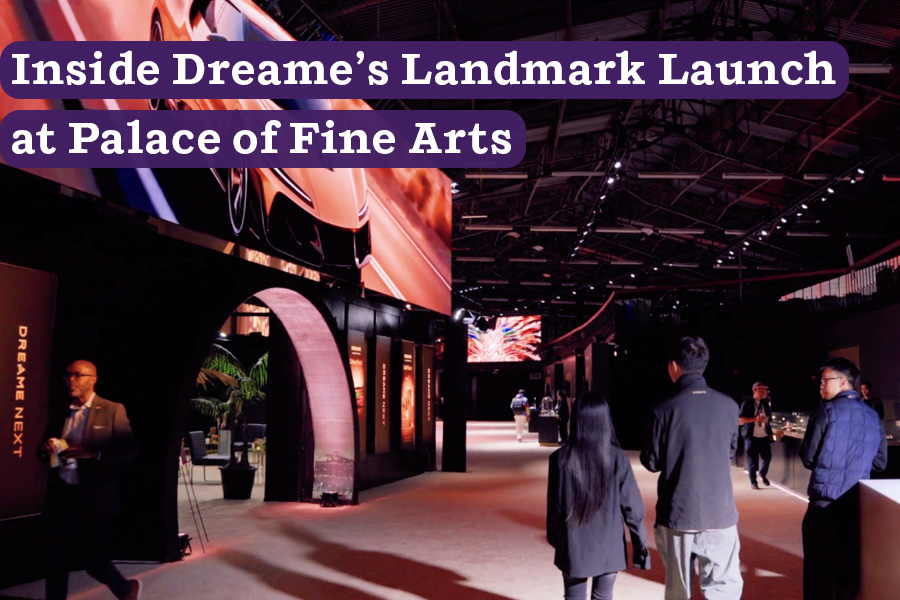
When Dreame Technology brought its Dreame Next 2026 global launch to San Francisco, the company was not planning a quiet product reveal. It was planning a four-day international showcase across smart mobility, smart home appliances, personal devices, premium personal care, and future-facing technology. The event took place at the Palace of Fine Arts, marking Dreame’s largest international showcase to date.
For Non Plus Ultra, the assignment came with all the ingredients of a major production: a global brand, international teams, ambitious renderings, high-profile guests, product demos, public attention, and a venue with real architectural presence.
It also came with a timeline that left almost no room for delay.
What followed was a fast-moving effort to rebuild a major global launch around a new venue, align teams across continents, and turn the Palace of Fine Arts into a fully realized showcase in a matter of days.
A Global Launch On a Major Time Crunch
Dreame Next 2026 was designed to introduce the company’s next decade of technology to the world. The brand organized the event around five themed segments: Drive Next, Living Next, Connect Next, Self Next, and Humanity Next. Each segment carried its own product announcements, technology demonstrations, and speaker moments.
That structure would have been complex under a traditional planning schedule. Dreame Next needed to support several launch environments at once, including product demo areas, presentation sessions, media moments, guest circulation, high-impact visual displays, and the many back-of-house systems required to keep a four-day showcase moving.
Then the timeline changed.
After unexpectedly losing its original venue, Dreame needed to rebuild the event around a new space almost immediately. What would typically be a three-to-six-month planning process had to be compressed into less than two weeks. Site plans, renderings, vendor needs, production schedules, delivery logistics, safety requirements, and compliance details all had to be revisited at speed.
NPU stepped into that pressure point and became the central operational hub for the event. The team worked quickly to interpret Dreame’s original renderings, adapt the creative vision to the Palace of Fine Arts, and help every vendor and production partner understand what needed to change. Design ideas had to be reshaped around the building’s layout. Traffic plans had to be rebuilt around the site. Load-in and load-out needed to be sequenced carefully. Permitting, compliance, site delivery, safety regulations, and venue logistics all had to move together.
That role became even more important because Dreame’s core team was based in China, with vendors, stakeholders, and production partners coordinating from multiple locations. Time zones, language, design interpretation, local regulations, and real-time production decisions all had to be managed quickly. NPU helped bridge those gaps so the event could keep moving without losing its shape.
Thanks to the long hours and tireless work of everyone involved over those very busy two weeks, Dreame had a well-built launch environment inside one of San Francisco’s most recognizable venues that was ready for the world stage by the time guests arrived.
Why the Palace of Fine Arts Worked for Dreame Next
Dreame Next needed more than a large room. It needed an iconic venue that could hold an ambitious ecosystem launch without making the experience feel scattered.
That is where the Palace of Fine Arts made sense. The event brought together product demos, keynote-style presentations, product reveals, media moments, guest circulation, and high-impact visual displays across several different product categories.
The Palace gave the event that range and then some. Its layout allowed Dreame to create multiple environments within one cohesive setting, moving guests through different product worlds without losing the sense that they were part of the same launch. A vehicle reveal could feel dramatic. Product demos could feel hands-on and approachable. Speaker sessions could carry the attention of the room. Media and guest flow could move around the experience without competing with the larger visual presentation.
The venue also shaped the aesthetic of the event. Dreame brought a future-facing technology showcase into one of San Francisco’s most recognizable architectural settings, which gave the launch a contrast that worked in its favor. The sleek product displays, lighting, staging, and branded environments felt sharper against the scale and character of the Palace. Instead of disappearing into a generic expo space, the event had a setting with its own visual identity.
That sense of place added weight to the launch. The Palace of Fine Arts already carries cultural recognition, especially in San Francisco. For a global brand introducing a major next-generation product ecosystem, that recognition helped make the event feel more significant before any product was revealed. The venue gave Dreame room to build, but it also gave the launch a level of presence that would have been difficult to create from scratch.
By the time guests moved through the space, the Palace was not just holding the event. It was helping frame the scale of Dreame’s ambition.
A High-Profile Guest List for a High-Visibility Launch
Dreame Next also drew attention because of the people on stage and in the room. Dreame confirmed that the guest lineup included Sebastian Thrun, Steve Wozniak, and Dwyane Wade, bringing together figures associated with autonomous driving, personal computing, and professional sports.
The broader speaker lineup included names from technology, academia, investment, and innovation, with discussions centered on AI-driven applications, product reinvention, manufacturing productivity, and the next decade of human technology.
That mix helped position the event as more than a product demo. It became a statement about where Dreame wants to go as a company. Dreame’s own event materials described the launch as the opening chapter of a ten-year, Silicon Valley-anchored journey of innovation.
For the venue team, that level of visibility raised the stakes. High-profile guests bring more attention, more media needs, tighter timelines, and greater pressure on the room to perform. The Palace of Fine Arts gave the event a setting with enough scale to carry the crowd and enough presence to match the ambition.
From Product Demos to the Hypercar Reveal
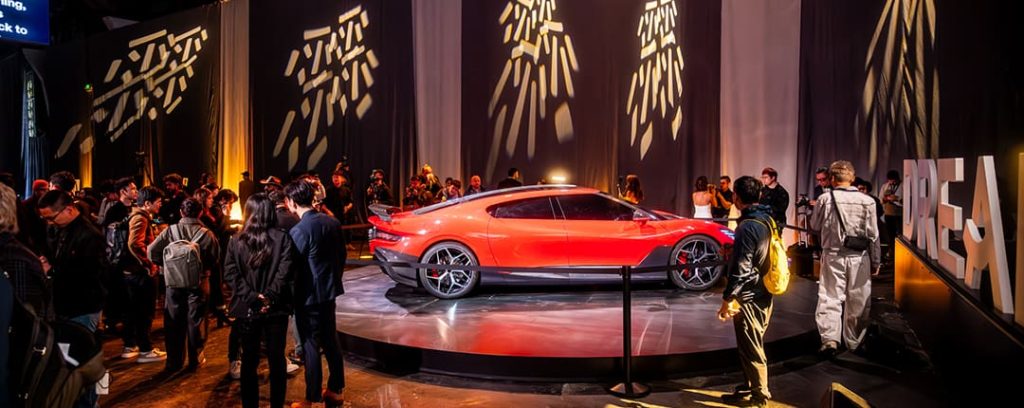
Once inside the Palace, guests moved through a showcase that stretched well beyond Dreame’s roots in home cleaning technology. The event brought together practical consumer products, future-facing concepts, and theatrical reveal moments, giving attendees a hands-on look at how broad the company’s ambitions have become.
Dreame Next featured a wide mix of products and concepts, including robot vacuums, wet/dry vacuums, air purification products, robot lawnmowers, haircare tools, TVs, smart rings, smartphones, appliances, and robotic home concepts. The event also included the Aurora Nex modular smartphone, introduced as part of the Connect Next segment, with Steve Wozniak joining Dreame’s Chang Xinwei on stage during that portion of the launch.
Then came the crescendo: the reveal of the Nebula Next 01 Jet Edition. Described by The Verge as a rocket-powered EV, the concept drew attention for Dreame’s claimed acceleration from 0 to 60 mph in 0.9 seconds.
Whether viewed as a prototype, a brand statement, or a spectacle designed to grab global attention, the hypercar did exactly what a major launch reveal is supposed to do. It created a moment people wanted to talk about.
Inside the Palace, the reveal had the scale and setting to land properly. The car did not appear as a disconnected stunt. It became the boldest expression of a larger Dreame story, one that moved from daily-use products to a much broader vision for the company’s future.
A Successful Launch in an Iconic San Francisco Venue
By the end of the four-day showcase, Dreame had used the Palace of Fine Arts to introduce a sweeping vision for its next chapter. This event announced a major expansion beyond the company’s roots in robot vacuums, with Dreame positioning itself across smart home, mobility, personal devices, and AI-driven consumer technology.
For NPU, the event showed what an experienced venue team can make possible when the timeline tightens and the stakes are high. It required fast decision-making, deep local knowledge, vendor coordination, production fluency, permitting support, and the ability to help a global team recover from a venue loss without losing momentum.
The Palace of Fine Arts gave Dreame the room, architecture, and cultural visibility to make the event feel significant. NPU helped make the space work.
That combination is what made Dreame Next possible at the Palace: an ambitious brand event, an adaptable landmark venue, and a team willing and able to move quickly when the timeline demanded more than the ordinary process could provide.
For companies planning large-scale product launches, corporate showcases, international summits, or immersive brand experiences in San Francisco, Dreame Next offers a useful reminder. The right venue is not just a backdrop. It shapes how the story is experienced, how guests move through the moment, and how much weight the event can carry.
To see how the Palace of Fine Arts or another one of NPU’s unique San Francisco venues could support your next event, connect with our team to schedule a site tour.